Saily eSIM France Review 2026: 30-Day Test, Speeds, Hotspot and Coverage

Updated: Aug 20
Disclosure: TechNovice is a Saily affiliate partner. Purchases made through links on this page may earn us a commission at no additional cost to you.
TL;DR: Best eSIM for France (Hands-On Field Test & Measured Speeds)
Overall Verdict: Based on my 30-day hands-on test in France, Saily is my preferred travel eSIM for travelers who need reliable mobile data and hotspot use. During the test, I used 59 GB of total mobile data and connected up to four devices simultaneously. My documented direct mobile tests ranged from 23.2 Mbps in a rural location to 354.3 Mbps over 5G in Montpellier.
Airalo & Holafly: Airalo and Holafly use different plan structures and may suit different travel needs. I did not conduct an equivalent 30-day France field test with either provider, so I do not rank their real-world French network performance in this review. See my dedicated Saily vs Airalo and Holafly vs Saily comparisons for a broader provider comparison.
Network Transparency: Saily connected directly to local carrier Orange France during physical outdoor field testing; regional network carrier availability across France is product page listed by Saily.
EU / UK / Swiss Roaming: EU travelers can utilize domestic mobile data in France under EU Roam Like at Home regulations; UK and Swiss travelers should verify home carrier EU roaming allowances before purchasing a Saily travel eSIM.
Discounts & Promo Codes: I most recently checkout-tested Saily coupon code TECH for 15% off an eligible Saily country plan. Eligibility can vary by plan, account, region or campaign. See my Saily Coupon Guide for the latest verification date, checkout evidence and eligibility details.
Research Box & Testing Methodology
Tested By: Nico Dudli (TechNovice)
Test Duration & Volume: 30-day field test in Montpellier, France (59 GB total data used across 4 simultaneous personal hotspot devices: 2 iPhones, 2 MacBooks).
Locations Tested: Montpellier (city center, local cafés), Saint-Guilhem-le-Désert, Palavas-les-Flots, Carnon, Annecy, and highway A9 (motorway between Montpellier and Nîmes at 130 km/h).
Networks Observed: Orange France (outdoor/rural), GSL Networks (indoor exit node).
Measured Speeds: Peak download speed of 354.3 Mbps (Outdoor 5G); 75.4 Mbps (Indoor 5G Café); 74.8 Mbps (Highway 5G at 130 km/h with active VPN); lowest speed of 23.2 Mbps (Rural LTE).

30 Days of Remote Work: The Montpellier Stress Test
Running an agency for a full month on Saily provided a rigorous real-world benchmark beyond standard airport connectivity tests:
Total Data Used: I recorded 59 GB of total mobile data use during the 30-day test. This figure describes my actual usage during the test and should not be interpreted as a 59 GB Saily France plan allowance.
Workload: I taught four online university courses via Google Meet and managed daily client work using the connection.
Multi-Device Tethering: I connected up to four devices simultaneously, including two iPhones and two MacBook Airs.
Verified Indoor Speed: 75.4 Mbps download at Café De la Sierra with two laptops active (Test ID: 7030759934).
Hotspot Tethering Test: A secondary tethered device reached 31.7 Mbps near Place de la Comédie.


My Favorite "Mobile Offices" in Montpellier
I used Saily while working from several locations around Montpellier. I did not publish a separate Speedtest ID for every café, so these locations are personal usage examples rather than individual benchmark tests.
Cafés where I worked: Coldrip Food & Cafe, Cafe Bun, De la Sierra, and the terrace at MO.CO. Panacée.
Other remote-work locations: The Babel Community (Antigone) and Gazette Café.
Everyday Travel Use in France
Outside remote work, I used the Saily connection for the everyday tasks that depend on mobile data while travelling:
Maps and navigation: loading maps, searching for destinations and checking live route information.
Transport: checking tram schedules and booking rides without relying on public Wi-Fi.
Translation: using online translation tools while shopping and travelling.
Travel apps: looking up restaurants, opening bookings and accessing web-based travel information.
GPS positioning itself does not require a mobile-data connection, and mobile wallets can perform many payment functions without continuous internet access. The practical benefit of the eSIM was keeping the surrounding travel apps and online services connected.
See my guide to the best travel apps for additional tools I use while travelling.
Saily vs. Airalo and Holafly for France
This article focuses on my real-world Saily test rather than reproducing a full provider comparison.
Saily worked particularly well for my trip because I needed hotspot sharing across several devices and enough connection stability for both normal travel use and remote work.
Airalo and Holafly use different plan structures and may suit different travellers. I compare those trade-offs separately in my Saily vs Airalo and Holafly vs Saily guides.
My recommendation in this France review is based on the Saily connection I actually used and measured. I did not run an equivalent 30-day France field test with Airalo or Holafly, so I do not use this article to rank their real-world French network performance.
Current promotional codes and documented checkout tests are maintained separately from this field-test review so that discount information does not become duplicated or outdated.
Saily France Speed Test Results
During my published France tests, the Ookla logs identified Orange France on the outdoor and rural measurements and GSL Networks on the indoor Café De la Sierra measurement. The highway test was recorded while a VPN was active, so its network log cannot be used to identify the local mobile network. The results below are location-specific measurements, not a guarantee of nationwide performance:
Scenario | Download | Upload | Connection |
|---|---|---|---|
Outdoor (City Center) | 354.3 Mbps | 35.9 Mbps | 5G |
Indoor (Café De la Sierra) | 75.4 Mbps | 5.4 Mbps | 5G |
Rural (Saint-Guilhem) | 23.2 Mbps | 8.6 Mbps | LTE |
Highway (Traveling) | 74.8 Mbps | 8.7 Mbps | 5G |
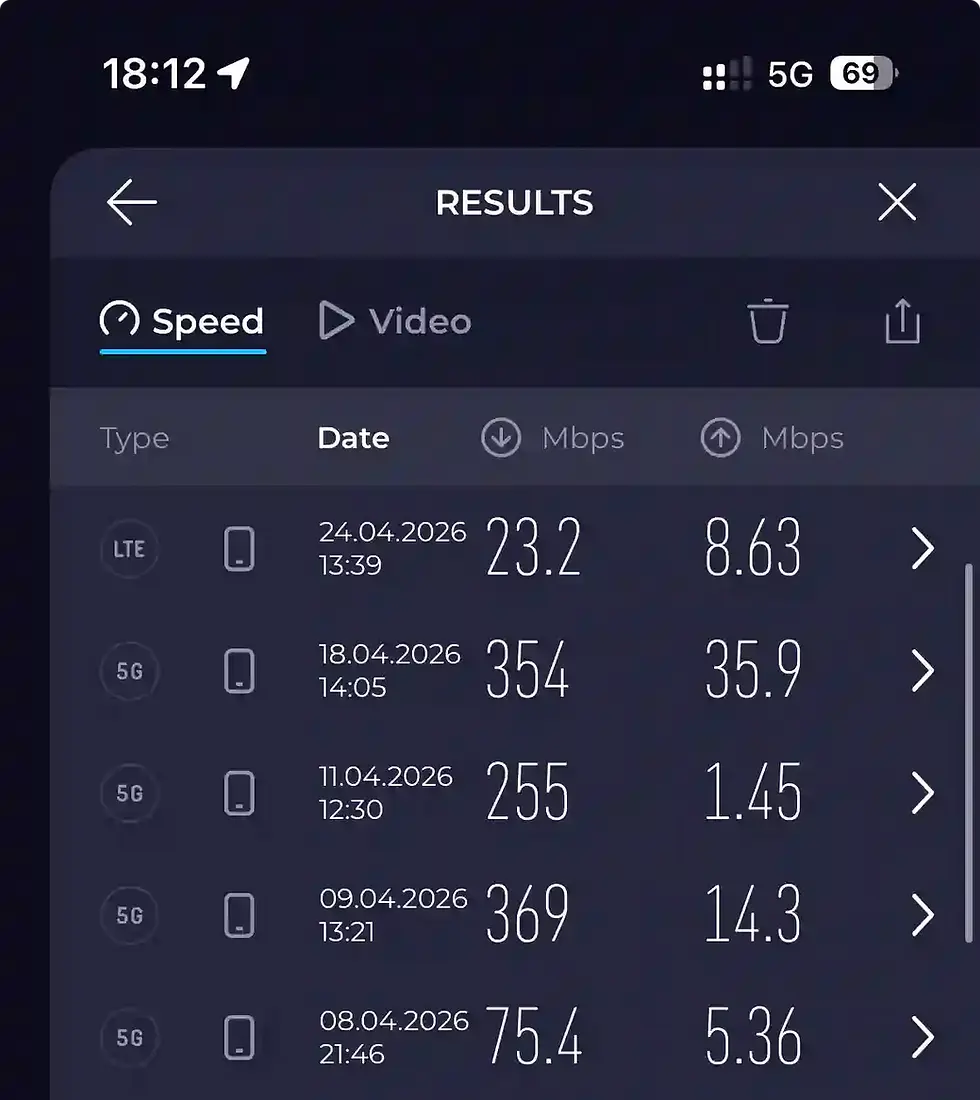
Full transparency: I publish both strong and weaker results rather than selecting only the fastest measurements. My documented France tests ranged from 354.3 Mbps in Montpellier to 23.2 Mbps in Saint-Guilhem-le-Désert. The highway test reached 74.8 Mbps with a VPN active and is therefore documented separately from the cleaner non-VPN benchmarks. In the locations covered by these published tests, I was able to maintain usable mobile connectivity, but these results do not guarantee the same experience elsewhere in France.
Published test evidence: The measurements above come from my own Ookla Speedtest history, with individual result IDs so the tests can be independently referenced.
Scenario | Date | Test ID | Connection log |
|---|---|---|---|
Outdoor (City Center) | 18.04.2026, 14:05 | 7042939739 | Saily, Orange France, Lat 43.604 / Lon 3.872 |
Indoor (Café De la Sierra) | 08.04.2026, 21:46 | 7030759934 | Saily, GSL Networks, Lat 43.601 / Lon 3.865 |
Rural (Saint-Guilhem) | 24.04.2026, 13:39 | 7050265733 | Saily, Orange France, Lat 43.732 / Lon 3.554 |
Highway (Traveling) | 28.04.2026, 16:04 | 7055238377 | Saily, recorded with a VPN active — the connection log shows a Zürich exit node, but the test was taken on the motorway between Montpellier and Nîmes |

Coverage context: Public mobile-network coverage maps can help show where French operators report 4G and 5G availability, but they should not be treated as proof that a roaming eSIM will achieve the same coverage or performance everywhere. My conclusions in this review are therefore based on the locations I personally tested rather than a nationwide coverage claim.
Case Study: Highway Connectivity Between Montpellier and Nîmes
I ran a mobile connectivity test on the motorway between Montpellier and Nîmes to see whether the Saily connection remained usable while the phone was moving at highway speed.
Network environment: approximately 130 km/h during the documented test.
Hardware: iPhone 15 Pro.
Active workload: a concurrent Google Meet call and Spotify stream.
Measured performance:
Download Speed: 74.8 Mbps
Upload Speed: 8.70 Mbps
Latency (Ping): 62 ms
Jitter: 52 ms
Test ID 7055238377 was recorded on 28 April 2026 while I was travelling on the motorway between Montpellier and Nîmes. A VPN was active during the test, which is why the connection log shows a Zürich exit node rather than the physical test location.
Because the VPN was active, the 74.8 Mbps result should not be treated as a clean benchmark of raw Saily mobile-network performance. VPN routing and encryption can affect throughput and latency, and the Speedtest location field cannot independently verify the physical test location. The physical location is based on my trip record.
What this test showed: during this specific drive, the Saily data connection remained usable with the VPN enabled. A Google Meet call and Spotify stream continued while the measured connection reached 74.8 Mbps download with 62 ms latency. This is evidence of usable connectivity during that drive, not a nationwide motorway benchmark.

Saily vs. Home-Carrier Roaming
Whether a travel eSIM saves money depends on the roaming benefits already included in your home mobile plan.
Travellers from the EU may already have usable roaming in France under their domestic plan. Travellers from Switzerland, the United States and other non-EU markets should check their existing France or EU roaming allowance before buying an additional eSIM.
If your home plan includes little or no affordable data in France, a travel eSIM can provide a predictable alternative without changing your primary phone number.
I deliberately don't reproduce home-carrier roaming prices here, since those tariffs change frequently. Current Saily plan structures are covered in my Saily eSIM Plans guide, while current promotional codes and checkout tests are maintained in my Saily Coupon Guide.
Coverage: From the Beach to Medieval Villages
Road Trip Stability: We drove from Switzerland through Annecy to the South. The connection was stable on the highways for Spotify and navigation.
Rural Performance: We visited Saint-Guilhem-le-Désert. I saw a brief drop to 3G on the road, while the phone returned to 4G/5G service inside the village. My published rural Speedtest recorded 23.2 Mbps download over LTE.
Coastal Use: Solid signal at Palavas-les-Flots and Carnon beach for streaming and social media.

Final Verdict
Saily performed well during my 30-day France test and supported the activities I actually needed while travelling and working remotely, including video calls, navigation and multi-device hotspot use. My documented direct mobile measurements ranged from 23.2 Mbps to 354.3 Mbps, with substantial differences between locations.
Based on this experience, I would use Saily again in France, particularly when hotspot use and remote work are important. This conclusion is based on my own Saily field test rather than an equivalent 30-day comparison with Airalo or Holafly, and it should not be interpreted as a guarantee of identical performance throughout France.
More Saily Guides on TechNovice
Looking for more detailed information? Here are my main Saily guides, field tests, comparisons and setup articles:
Saily guides and comparisons:
Best Travel Apps 2026
More Saily eSIM country guides:
FAQ: Saily eSIM France (2026)
Is there a Saily discount code for France?
Yes. In my latest checkout test, Saily coupon code TECH applied 15% off an eligible Saily country plan. Eligibility can vary by plan, account, region or campaign, so this result should not be interpreted as a guarantee for every Saily plan. I document the latest verification date, checkout evidence and current eligibility details in my Saily Coupon Guide.
Can I use Saily as a hotspot for my family?
Yes. During my France test, I connected up to four devices simultaneously, including two iPhones and two MacBooks. Hotspot conditions can depend on the current plan, so check the plan details if tethering is important for your trip.
Does my phone need to be carrier-unlocked?
Yes. Your phone must support eSIM and allow eSIM profiles from another provider. If your device was purchased through a mobile carrier, check its lock status before travelling rather than assuming an eSIM from Saily can be installed.
Having trouble after setup? Saily eSIM problems & fixes
Can I keep my original phone number, WhatsApp, and iMessage active?
Yes. On Dual SIM devices, you can keep your primary SIM active for calls and SMS while assigning Saily exclusively for mobile data. This allows WhatsApp and iMessage to remain registered to your original phone number without interruption. To avoid unexpected charges, make sure data roaming is enabled for your Saily eSIM line and disabled for your primary SIM line.


