Best eSIM for Indonesia (2026): My Saily eSIM Test & Speed Results

Disclosure: TechNovice is supported by affiliate partnerships. Saily is a partner of this site, but this recommendation is based on my documented field testing in Indonesia and separate provider research. I may earn a commission if you buy through TechNovice at no additional cost to you.
I tested Saily across Bali and Lombok and recorded eight documented mobile measurements between August 25 and September 4, 2026. Based on those field-test results, Saily is my pick for the best eSIM for Indonesia. My test series produced a median download speed of 151.53 Mbps, with results ranging from 11.95 Mbps to 348.93 Mbps.
Best eSIM for Indonesia: Based on my eight field tests in Bali and Lombok, Saily is my overall pick, with a median download speed of 151.53 Mbps.
My main takeaway is that Saily was comfortably fast enough for the travel tasks I care about, including maps, messaging, streaming, cloud apps, and hotspot use. Performance varied substantially by location, so I would not treat the 348.93 Mbps peak as typical.
Airalo remains worth comparing if its current package sizes fit your trip better, while Holafly is the stronger alternative if unlimited data is your main priority. I did not run equivalent side-by-side Indonesia tests of all three providers, so I do not claim Saily is universally faster.
Saily discount code TECH gives 15% off eligible plans. See my Saily coupon codes and latest checkout tests for current verification.
Key facts
My overall pick: Saily
Tester: Svenja Eichenberger
Indonesia field tests: 8
Locations: Karang Daye, Mataram, Tembuku, Sulahan, and Baturiti
Islands tested: Lombok and Bali
Test period: August 25 to September 4, 2026
Median download: 151.53 Mbps
Median upload: 10.55 Mbps
Median latency: 153 ms
Download range: 11.95–348.93 Mbps
Recorded connection types: 7× 5G, 1× LTE
Best for unlimited-data-focused trips: Holafly
Indonesian +62 number: Not included with Saily's standard data plan
Optional phone number: Separate US +1 call/text feature

Why I recommend Saily for Indonesia
I recommend Saily because I personally tested it at five locations across Bali and Lombok instead of relying only on provider specifications.
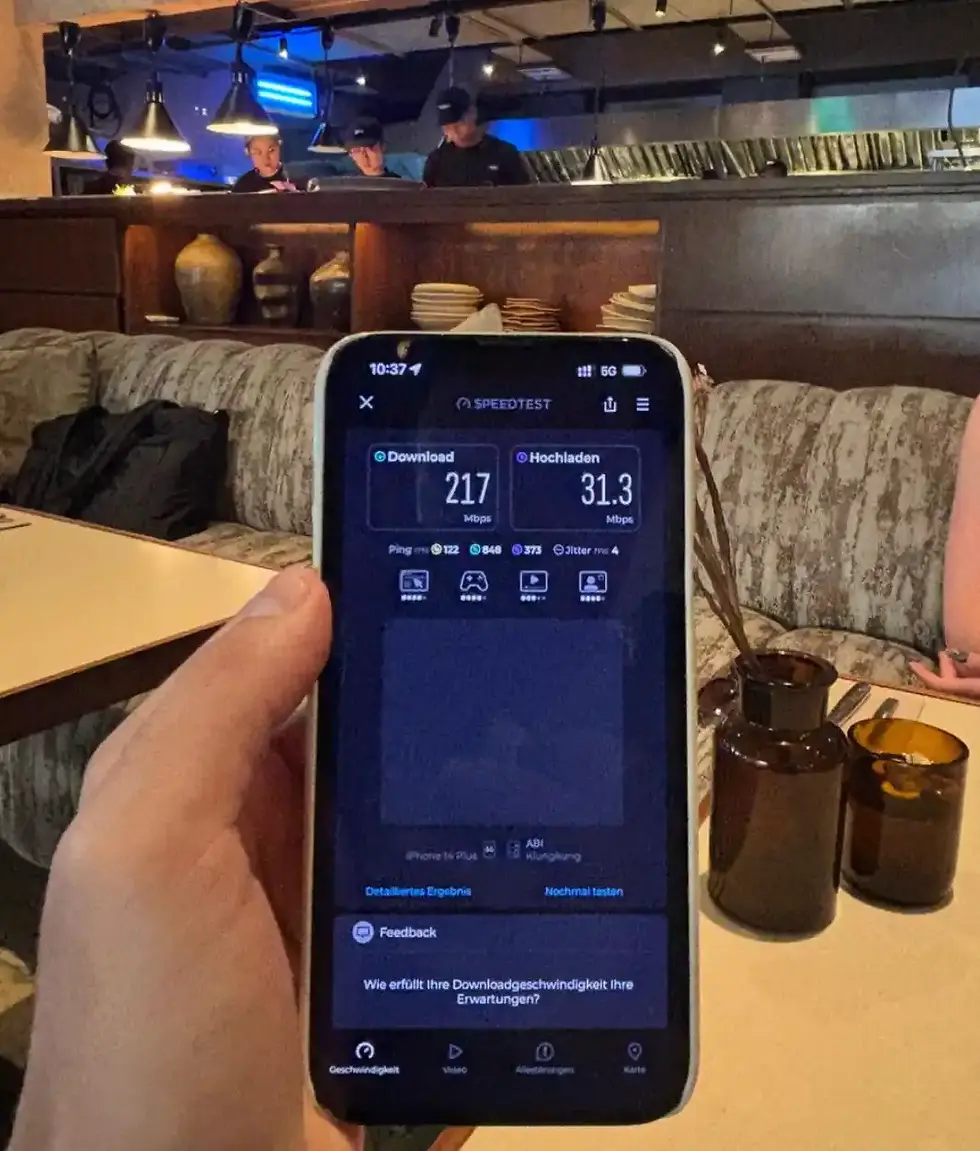
The most useful number from my Indonesia dataset is not the 348.93 Mbps peak. For me, the 151.53 Mbps median download across all eight cellular measurements is much more meaningful because it better represents the middle of what I actually experienced.
At around 152 Mbps, I found the connection more than fast enough for navigation, messaging, video calls, streaming, cloud apps, and laptop hotspot use.
The fastest result reached 348.93 Mbps. At that level, I would comfortably use the connection for large downloads, cloud transfers, video conferencing, high-resolution uploads, and demanding hotspot use.
The slowest result was 11.95 Mbps. That was much more limited, but I would still expect maps, messaging, browsing, restaurant searches, and bookings to work without difficulty.
For me, that spread is the important lesson: Saily can be very fast in Indonesia, but local conditions matter far more than a single headline speed.
For my broader experience with the provider across multiple trips, see my full Saily eSIM review.
How fast was Saily in my Indonesia test?
Across my eight documented cellular measurements in Bali and Lombok, I recorded a median download speed of 151.53 Mbps and a median upload speed of 10.55 Mbps.
Indonesia field testing | Result |
|---|---|
Documented cellular measurements | 8 |
Median download | 151.53 Mbps |
Median upload | 10.55 Mbps |
Median latency | 153 ms |
Fastest download | 348.93 Mbps |
Slowest download | 11.95 Mbps |
Test period | August 25 to September 4, 2026 |
I find the median more useful than highlighting only the fastest measurement because performance changed substantially between locations.
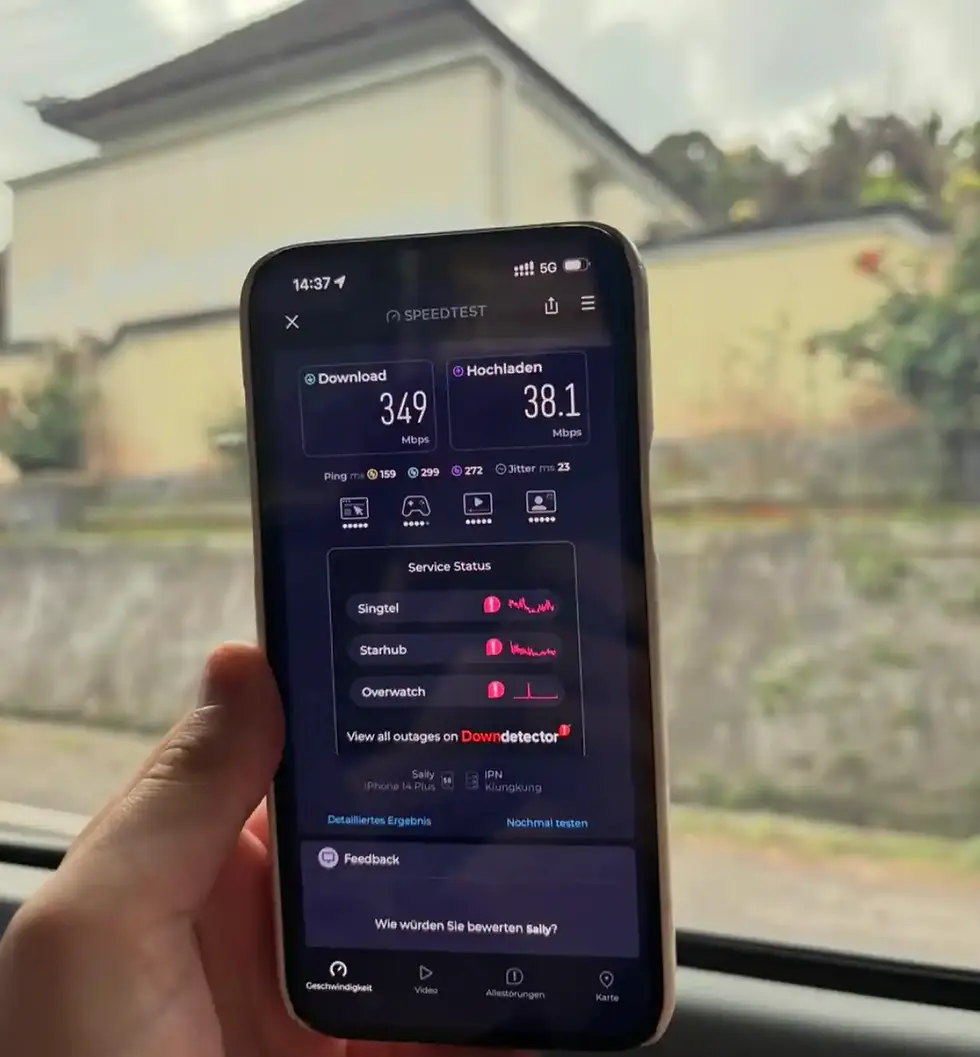
My fastest Indonesia result: 348.93 Mbps
The 348.93 Mbps peak I recorded in Tembuku, Bali shows the upper end of what I experienced.
That test also reached 38.11 Mbps upload with 159 ms latency on 5G.
At this level, I would not consider mobile data the bottleneck for normal travel use. I would comfortably use the connection for video conferencing, large cloud transfers, high-resolution uploads, streaming, and laptop tethering.
I would not, however, use this one result to describe typical Saily performance in Indonesia.
My slowest Indonesia result: 11.95 Mbps
The 11.95 Mbps low point I recorded in Karang Daye, Lombok was on LTE, with 11.80 Mbps upload and 147 ms latency.
That was dramatically slower than my strongest 5G results, but I still found it sufficient for navigation, messaging, restaurant searches, bookings, and normal browsing.
For me, the 151.53 Mbps median is therefore the most useful headline figure.
Saily eSIM Coverage and Speed in Bali and Lombok
My test results show that Saily can deliver strong 5G performance in both Bali and Lombok, but they do not prove consistent coverage across either island or Indonesia as a whole.
The contrast on Lombok was particularly clear. I measured 11.95 Mbps on LTE in Karang Daye, then 286.03 Mbps on 5G in Mataram.
Bali also showed meaningful variation. In Tembuku, my two 5G tests produced a location median of 263.96 Mbps. In Baturiti, I reached 299.33 Mbps, while Sulahan was more variable, with three results ranging from 38.67 to 124.06 Mbps.

One of my Sulahan tests also recorded 1,092 ms latency. Two later measurements at the same location fell back to 130 and 127 ms.
I therefore treat the 1,092 ms result as an outlier. Temporary congestion, routing, or another network condition could explain it, but I cannot determine the exact cause from a Speedtest alone.
I also recorded Wi-Fi measurements on Gili Trawangan. I excluded those from my Saily mobile statistics because they did not measure the cellular eSIM connection.
Which mobile network does Saily use in Indonesia?
Saily lists Telkomsel 4G LTE and 5G connectivity for its Indonesia plans.
I keep that provider information separate from my Speedtest data.
I do not infer the underlying mobile carrier from Speedtest server names. A Speedtest server reflects test infrastructure or routing and is not reliable proof of the radio network serving my phone.
I also would not interpret my measurements as proof of Saily or Telkomsel performance throughout Indonesia. Signal strength, terrain, congestion, roaming arrangements, device capability, and automatic network selection can all affect the result.
Saily vs. Airalo vs. Holafly for Indonesia
I would choose Saily for most Indonesia trips because it is the provider I personally tested in the country. Airalo and Holafly remain stronger for specific priorities.
Provider | Best for | My take |
|---|---|---|
Saily | Overall choice with direct Indonesia field testing | My first choice for most travelers |
Airalo | Travelers comparing different fixed and unlimited packages | Worth checking if its current package fits your trip better |
Holafly | Travelers prioritizing unlimited data | Stronger if you do not want to monitor normal data usage |
Local Indonesian SIM/eSIM | Travelers needing an Indonesian +62 number | Better if you need local mobile services |
Airalo offers both fixed-data and unlimited Indonesia eSIM packages.
Holafly is the alternative I would look at first if unlimited data were my main priority. If I planned to use a laptop hotspot heavily, I would check its current tethering allowance before buying.
I have not compared Saily, Airalo, and Holafly simultaneously on the same device, at the same location, and at the same time in Indonesia.
I therefore do not claim that Saily is objectively faster than either competitor.
What I can say is that Saily is the provider I can evaluate most confidently for Indonesia because I personally used and measured it there.
If you are deciding specifically between providers, see my Saily vs. Airalo comparison and Holafly vs. Saily comparison.
Which eSIM would I choose for an Indonesia trip?
For my own Indonesia trip, I would choose Saily unless I specifically wanted an unlimited-data-focused option or needed a local Indonesian phone number.
My decision would be:
Saily if I wanted the option backed by my own Indonesia field-test data
Airalo if its current package structure fitted my itinerary better
Holafly if unlimited data was my main priority
A local Indonesian SIM/eSIM if I needed a +62 number
For normal tourist use, I would not automatically buy unlimited data.
Navigation, messaging, restaurant searches, bookings, browsing, and moderate social media use usually require much less data than constant video streaming, large cloud uploads, or heavy laptop tethering.
For current allowances and plan types, see my Saily eSIM plans guide.
Does Saily give you an Indonesian phone number?
No. Saily's standard Indonesia data plan does not include a local Indonesian +62 phone number.
Saily also offers calls and SMS through a separate phone-number feature using a US +1 number rather than an Indonesian local number.
I think this distinction matters because simply describing Saily as permanently “data-only” is no longer the full picture.
If I specifically needed a +62 number for local calls, registrations, or SMS services, I would choose a local Indonesian SIM or eSIM.
Indonesia plan or Asia regional eSIM?
I would choose an Indonesia plan for an Indonesia-only trip and compare it with an Asia regional plan if I were traveling through several countries.
That becomes relevant on trips combining Indonesia with destinations such as Thailand, Vietnam, Singapore, or Malaysia.
The right choice depends on current allowances, validity periods, and pricing. Those details can change, so I would compare the live offers instead of relying on a static price table.
For US travelers, I would also compare the cost against the international roaming option from the existing carrier. With an unlocked, eSIM-compatible dual-SIM phone, it is usually possible to keep the primary US line active while routing mobile data through the travel eSIM.
How I would set up Saily for Indonesia
I prefer installing a travel eSIM before departure while I still have reliable Wi-Fi.
Install Saily before traveling.
Select Saily as the mobile-data line.
Enable data roaming for the Saily profile.
Keep network selection automatic initially.
Only troubleshoot manually if the connection does not establish itself.
For detailed instructions, see my Saily setup guide for iPhone and Saily Android setup guide.
If Saily does not connect after arrival, I would first toggle Airplane Mode, check that data roaming is enabled for the Saily line, and restart the mobile connection before changing more advanced settings.
For more detailed fixes, see my Saily eSIM troubleshooting guide.
Who should not choose Saily for Indonesia?
I would not recommend Saily to everyone.
I would choose something else if I:
specifically needed an Indonesian +62 phone number
wanted an unlimited-data-first product regardless of other trade-offs
needed a long-term local Indonesian mobile plan
depended heavily on one particular local carrier
required guaranteed performance in every location
For a normal tourist trip focused on navigation, messaging, bookings, streaming, and occasional hotspot use, I would choose Saily.
FAQ
What is the best eSIM for tourists in Indonesia?
My overall pick for most tourists is Saily because I personally tested it across eight cellular measurements in Bali and Lombok.
I recorded a 151.53 Mbps median download speed, with individual results ranging from 11.95 to 348.93 Mbps.
I would compare Holafly if unlimited data were my main priority and Airalo if its current package structure fitted my trip better.
Is Saily good for Indonesia?
Based on my testing, yes overall, although performance varied by location.
Across my eight cellular measurements, Saily delivered a 151.53 Mbps median download speed, 10.55 Mbps median upload, and 153 ms median latency.
Seven of my eight measurements used 5G.
Does Saily work in Bali?
Yes in the Bali locations where I tested it.
I recorded six cellular Speedtests in Tembuku, Sulahan, and Baturiti, all on 5G. My individual download speeds ranged from 38.67 to 348.93 Mbps.
I would not use those measurements to claim uniform coverage everywhere on Bali.
Is Saily good for Lombok?
It worked in both Lombok locations where I tested it, but the results differed substantially.
I measured 11.95 Mbps on LTE in Karang Daye and 286.03 Mbps on 5G in Mataram.
Two locations are not enough for me to claim consistent performance across the whole island.
Does Saily support 5G in Indonesia?
Yes, where the local network provides it.
Seven of my eight cellular measurements in Indonesia were recorded on 5G.
Does Saily give you an Indonesian phone number?
No.
Saily's standard Indonesia plan does not provide a +62 number. Its separate phone-number feature uses a US +1 number.
If I specifically needed a local Indonesian number, I would choose a local SIM or eSIM.
About This Test & Methodology
I personally conducted the eight cellular Indonesia measurements used in this review for TechNovice. Tester: Svenja Eichenberger.
Primary data source: my own mobile speed tests recorded in Indonesia using Speedtest by Ookla.
I used Speedtest by Ookla for all eight cellular measurements included in this review.
I recorded the tests in Karang Daye and Mataram on Lombok, plus Tembuku, Sulahan, and Baturiti on Bali between August 25 and September 4, 2026.
Across my eight tests, I measured:
Median download: 151.53 Mbps
Median upload: 10.55 Mbps
Median latency: 153 ms
Download range: 11.95–348.93 Mbps
Connection types: seven 5G tests and one LTE test
I use the median as my primary summary statistic because mobile measurements can contain major outliers.
The clearest example is the 1,092 ms latency measurement I recorded in Sulahan. Two later tests at the same location recorded 130 and 127 ms. I include the outlier rather than deleting it, but I do not claim to know whether routing, congestion, or another temporary condition caused it.
I also exclude measurements that did not test the cellular eSIM. I recorded two results on Gili Trawangan over Wi-Fi, so they are not included in my eight-test Saily dataset.
I separate my own field measurements from provider information. I personally measured every speed result described in this article, while network support, plan capabilities, hotspot functionality, and phone-number features were researched separately.
I also treat Speedtest server names only as test infrastructure and never as proof of the underlying mobile carrier.
Finally, these results reflect my test dates, locations, device conditions, and network environment. Mobile performance can change with congestion, terrain, roaming arrangements, routing, device capability, and exact position.
My recommendation is therefore based on my documented real-world testing in Indonesia, not on a claim that every traveler will receive identical performance.