Best eSIM for Thailand (2026): Saily Tested Across Three Trips

Updated: Sep 12
Disclosure: TechNovice is supported by affiliate partnerships. Saily is a partner of this site, but this recommendation is based on my own documented field testing in Thailand and separate provider research. I may earn a commission if you buy through TechNovice at no additional cost to you.
Saily is my current pick for the best eSIM for Thailand because it is the provider I have personally used and tested across three separate Thailand trips. My testing covered Bangkok, Koh Chang, Koh Samui, Koh Yao Noi, Koh Kood, and, in my latest round, Koh Phangan.
In my five directly comparable no-VPN measurements from Bangkok and Koh Samui in August 2026, I recorded a median download speed of 358.3 Mbps, with results ranging from 300.6 Mbps to 717.8 Mbps. I also documented additional real-world tests on Thai islands, including Koh Chang, Koh Yao Noi, Koh Kood, and Koh Phangan. I keep tests with different conditions separate rather than combining them into a misleading nationwide average.
Airalo, Holafly, Nomad, AIS, and other Thailand eSIM options remain worth comparing for specific needs. I did not conduct equivalent side-by-side Thailand field tests of those providers, so I do not claim Saily is universally faster.
Saily discount code TECH gives 15% off eligible plans. See my Saily coupon codes and latest checkout tests for current verification.
Key facts
My overall pick: Saily
Tester: Nico Dudli, TechNovice
Thailand trips tested: 3
Field-test locations: Bangkok, Koh Chang, Koh Samui, Koh Yao Noi, Koh Kood, and Koh Phangan
Comparable no-VPN measurements: 5 in Bangkok and Koh Samui
Median download: 358.3 Mbps
Median upload: 75.2 Mbps
Median latency: 102 ms
No-VPN download range: 300.6–717.8 Mbps
Koh Chang remote-work test: 246 Mbps down / 221 Mbps up / 64 ms, NordVPN active
Koh Yao Noi test: 56.5 Mbps down / 1.95 Mbps up / 533 ms, NordVPN active
Koh Phangan field test: documented separately from the five-test benchmark dataset
Observed Thai mobile network: TrueMove H 5G during my Koh Yao Noi test
Thai +66 number: Not included with Saily's Thailand data plan
Optional phone number: Separate US +1 call/text feature

Why I recommend Saily for Thailand
I recommend Saily because I have personally used it across three Thailand trips instead of relying only on provider specifications and coverage claims.
The strongest evidence is not the 717.8 Mbps peak. For me, the 358.3 Mbps median across the five comparable no-VPN measurements is more useful because it represents the middle of what I measured in Bangkok and Koh Samui.
Those speeds provided substantially more bandwidth than I normally need while traveling for:
Google Maps and navigation
Grab
WhatsApp and messaging
video calls
streaming
cloud apps
laptop hotspot use
file transfers
The earlier and island tests add context that Bangkok benchmarks alone cannot provide.
On Koh Chang, I worked over Saily using video calls, research, messaging, uploads, and laptop tethering. On Koh Kood, several Google Meet calls worked smoothly. Koh Yao Noi produced a much less responsive measurement. My latest Koh Phangan testing adds another island environment to the field evidence.
For me, that is the useful conclusion: Saily worked across a varied Thailand itinerary, but performance can differ substantially by exact location, network conditions, and test setup.
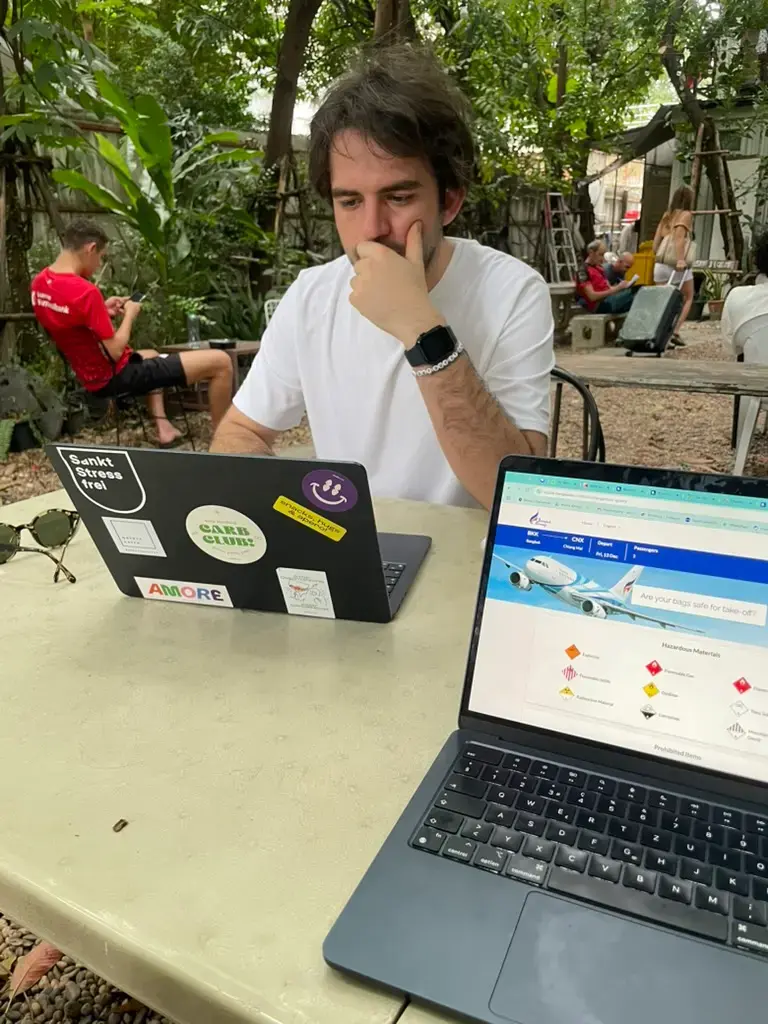
How fast was Saily in my Thailand tests?
Across my five directly comparable no-VPN measurements in Bangkok and Koh Samui in August 2026, I recorded a median download speed of 358.3 Mbps and a median upload speed of 75.2 Mbps.
August 2026 comparable testing | Result |
|---|---|
No-VPN measurements | 5 |
Median download | 358.3 Mbps |
Median upload | 75.2 Mbps |
Median latency | 102 ms |
Fastest download | 717.8 Mbps |
Slowest download | 300.6 Mbps |
Locations | Bangkok and Koh Samui |
I keep the Koh Chang and Koh Yao Noi measurements separate because NordVPN was active during those tests. I also keep additional Koh Phangan field evidence separate from this five-test aggregate rather than retroactively changing a dataset collected under defined conditions.
VPN routing and encryption can affect throughput and latency. Combining measurements taken under different conditions would make the results look more comparable than they actually are.
Bangkok: the strongest cluster of results
Bangkok produced the strongest group of directly comparable results in my August 2026 testing.
I measured:
Location | Download | Upload | Latency | Condition |
|---|---|---|---|---|
Bangkok | 717.8 Mbps | 75.2 Mbps | 116 ms | No VPN |
Bangkok | 536.4 Mbps | 79.5 Mbps | 99 ms | No VPN |
Bangkok | 358.3 Mbps | 66.2 Mbps | 102 ms | No VPN |
Bangkok Airport | 327.4 Mbps | 74.6 Mbps | 100 ms | No VPN |
The four Bangkok measurements produced a median download speed of about 447 Mbps.
The 717.8 Mbps result shows the upper end of what I measured, but I would not describe it as typical Saily Thailand performance. The group of Bangkok results is more informative than the peak alone.
At Suvarnabhumi Airport, 327.4 Mbps download and 74.6 Mbps upload were already far beyond what I needed for maps, messages, Grab, travel research, cloud services, or normal laptop work.

Koh Samui: 300.6 Mbps at the airport
My Koh Samui Airport test reached 300.6 Mbps download and 83.6 Mbps upload, with 114 ms latency and no active VPN.
That result extends the comparable August dataset beyond Bangkok, but one airport measurement cannot predict performance everywhere on Koh Samui.
Speedtest displayed SCM Technologies and labeled the location Surat Thani. I do not use the Speedtest server name to identify the underlying mobile carrier.
Koh Chang: my strongest remote-work evidence
Koh Chang provided more useful remote-work evidence than a standalone benchmark because I actually worked over the connection.
I used Saily for normal workdays involving video calls, file uploads, research, messaging, and laptop connectivity.
My December 2025 measurement recorded:
246 Mbps download
221 Mbps upload
64 ms latency
NordVPN active
Because NordVPN was active, I treat this as a real-world connectivity test rather than a controlled measurement of raw Saily network performance.
For the workloads I actually used on Koh Chang, the connection was sufficient. That does not guarantee the same performance at every resort or part of the island.
For more of my long-term travel testing, see my Saily eSIM travel experience.
Koh Yao Noi: the important weaker result
Koh Yao Noi produced the weakest measured experience in my Thailand testing and is an important counterexample to the much faster Bangkok results.
I measured:
56.5 Mbps download
1.95 Mbps upload
533 ms latency
NordVPN active
TrueMove H 5G observed directly on the phone
A 56.5 Mbps download connection is still sufficient for maps, messaging, browsing, and many streaming tasks.
The bigger issue was the 533 ms latency. At that level, a connection can feel noticeably sluggish during interactive workloads such as video calls even when the download speed looks adequate.
I cannot determine from this measurement alone how much of the latency came from NordVPN, roaming routing, local network conditions, congestion, or another factor.
My practical takeaway is simple: when I arrive somewhere more remote, I test the connection before depending on it for an important video call.
That result should not be generalized to every Thai island. On Koh Kood, several Google Meet calls worked smoothly during my normal use.

Koh Phangan: another island test in August 2026
My latest Thailand testing also included Koh Phangan, giving me another real-world island data point rather than relying only on Bangkok and airport measurements.
One photo-documented Koh Phangan speed test showed approximately 253 Mbps download and 324 Mbps upload.
That is more than enough bandwidth for the travel and remote-work tasks I normally perform, including video calls, uploads, streaming, and laptop tethering.
I keep this Koh Phangan result separate from the five-test Bangkok and Koh Samui aggregate because I do not want to silently change the methodology of that original comparable dataset.
A second field-test image from the latest Thailand testing showed 22.6 Mbps download, 45.9 Mbps upload, and 139 ms latency. Because the image itself does not provide the same location metadata as my documented Koh Phangan photo, I do not assign that measurement to Koh Phangan solely from the photograph.
The contrast is useful in itself: individual mobile speed tests can vary substantially even during the same broader trip, so I put more weight on repeated use across locations than on one headline speed.
Which mobile networks did Saily use in Thailand?
I directly observed TrueMove H 5G on my phone during the Koh Yao Noi test. I treat that as a confirmed observation from that specific test, not proof that every Saily customer in Thailand will connect to TrueMove H.
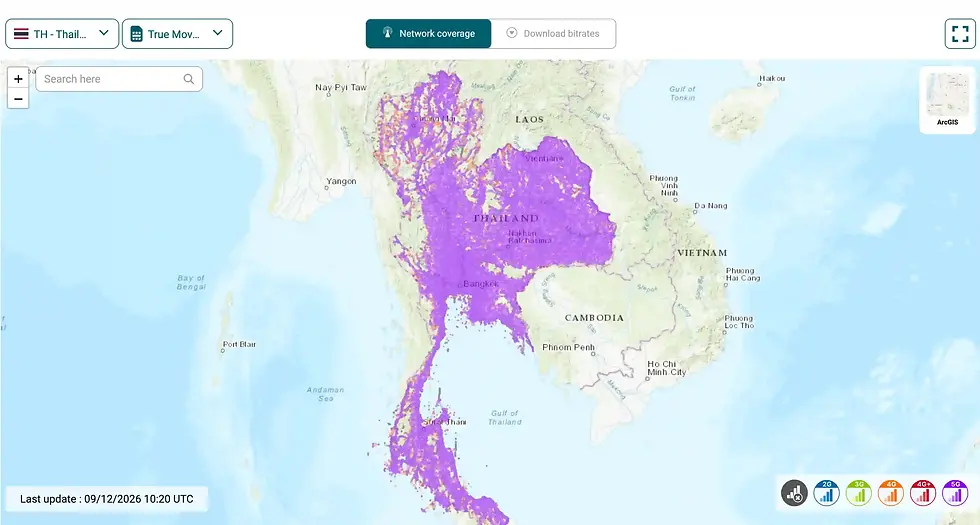
I also keep mobile-network identification separate from Speedtest infrastructure.
Speedtest displayed names including SCM Technologies, Bangmod Enterprise, NT Corporate, and 3BB during different measurements. Those are Speedtest server or connection-log observations, not sufficient evidence of the underlying mobile carrier.
Roaming partners, automatic network selection, congestion, signal strength, routing, and exact location can all affect the connection.
Travelers specifically researching an AIS eSIM Thailand plan should compare AIS's tourist eSIM options directly. A local carrier eSIM solves a somewhat different problem from an international travel eSIM such as Saily.
Saily vs. Airalo vs. Holafly vs. Nomad for Thailand
I would personally choose Saily for most Thailand trips because it is the provider I have actually tested across three trips. Airalo, Holafly, and Nomad remain legitimate alternatives for different priorities.
Provider | Best for | My take |
|---|---|---|
Saily | Overall choice backed by my Thailand field tests | My first choice for most travelers |
Airalo | Travelers comparing established fixed-data travel eSIMs | Worth comparing if its current Thailand package better matches your trip |
Holafly | Travelers prioritizing unlimited-style data | Worth considering when avoiding a fixed allowance is the priority |
Nomad | Travelers shopping between fixed-data plans | Compare current allowance, validity, and value |
Local Thai SIM/eSIM | Thai number, longer stays, local carrier service | Better when local mobile service matters more than pre-trip convenience |
I have not run simultaneous Thailand speed tests of Saily, Airalo, Holafly, and Nomad on the same phones in the same locations.
I therefore do not claim Saily is objectively faster than Airalo, Holafly, or Nomad.
What I can say is that Saily is the Thailand travel eSIM I can evaluate most confidently from first-hand evidence.
For dedicated comparisons, see my Saily vs. Airalo and Holafly vs. Saily guides.
Which eSIM would I choose for a Thailand trip?
For my own Thailand trip, I would choose Saily again unless I specifically needed a Thai phone number or a local carrier plan.
My decision would be:
Saily if I wanted the option I have personally tested across multiple Thailand trips
Airalo if its current fixed-data package suited my trip better
Holafly if unlimited-style data was my main priority
Nomad if its current allowance and validity offered better value for my itinerary
AIS, True, dtac, or another local option if I needed a Thai +66 number or longer-term local service
For normal tourism, I would not automatically buy an unlimited plan.
Google Maps, Grab, messaging, hotel research, restaurant searches, and moderate social-media use generally require much less data than streaming, cloud backups, frequent video uploads, or full-time hotspot use.
Remote workers and heavy content creators should allow substantially more data. For current package structures, see my Saily eSIM plans guide.
Does Saily give you a Thai phone number?
No. Saily's Thailand data plan does not include a local Thai +66 phone number.
Saily separately offers an optional US +1 phone number for calls and texts.
That distinction matters because describing Saily simply as “data-only” no longer tells the complete story.
The Thailand eSIM provides travel connectivity rather than a local Thai number. The separate phone-number feature can be useful if you want an additional travel number, but it should not be confused with a Thai carrier number.
OTP and account-verification compatibility can vary between services.
For most tourists, the missing +66 number is not a major limitation because WhatsApp, FaceTime, iMessage, Telegram, and other internet-based services work over the Saily data connection.
If I specifically needed a Thai number for local calls, registrations, or SMS verification, I would compare a local Thai SIM or eSIM.
Thailand plan or Asia regional eSIM?
I would choose a Thailand plan for a Thailand-only trip and compare it with an Asia regional plan if I were traveling through several countries.
This is particularly relevant for itineraries combining Thailand with destinations such as Vietnam, Laos, Singapore, Indonesia, or Japan.
A regional plan can reduce the need to purchase another eSIM every time you cross a border.
Exact destinations, allowances, validity periods, and prices can change, so I would compare the current regional offer with separate country plans immediately before buying.
Heading to Vietnam after Thailand? My Best eSIM for Vietnam guide covers my separate travel testing there.
How I would set up Saily for Thailand
I prefer installing a Thailand eSIM before departure while I still have reliable Wi-Fi.
Install Saily before traveling.
Keep your primary SIM installed if you still need your normal number.
Select Saily as the mobile-data line after arrival.
Enable data roaming for the Saily eSIM.
Leave network selection automatic initially.
Only switch networks or troubleshoot manually if the connection does not establish itself.
For US travelers with an unlocked Dual SIM iPhone or Android phone, this setup is particularly useful because you can retain your US number while using Saily for Thailand mobile data.
Check your home carrier's roaming settings before departure. Keeping a US line active abroad can potentially create roaming charges depending on the carrier and configuration.
For detailed instructions, see my Saily setup guide for iPhone.
If the connection does not work after arrival, I would first toggle Airplane Mode and restart mobile data before changing more advanced settings. My Saily troubleshooting guide covers the main fixes separately.
Who should not choose Saily for Thailand?
I would not recommend Saily to every Thailand traveler.
I would choose something else if I:
specifically needed a Thai +66 phone number
wanted a long-term local Thai mobile plan
preferred a particular AIS, True, or dtac tourist package
found an unlimited-data-focused plan that better matched my usage
already had affordable Thailand roaming through my existing carrier
required guaranteed performance at a specific remote location
For a typical tourist trip where I mainly need navigation, Grab, bookings, messaging, streaming, social media, and occasional hotspot use, I would choose Saily.
FAQ
What is the best eSIM for Thailand in 2026?
My current pick for the best eSIM for Thailand is Saily because I have personally used and tested it across three Thailand trips.
My five comparable no-VPN measurements in Bangkok and Koh Samui produced a 358.3 Mbps median download speed, while additional field use covered Koh Chang, Koh Yao Noi, Koh Kood, and Koh Phangan.
Airalo, Holafly, Nomad, and local Thai carriers remain worth comparing for different plan structures and use cases.
Is Saily eSIM good in Thailand?
In my testing, yes overall, but performance varied by location.
I successfully used Saily across Bangkok and several Thai islands for travel connectivity and remote work. My results ranged from very fast Bangkok measurements to a much higher-latency experience on Koh Yao Noi.
What network does Saily use in Thailand?
I directly observed TrueMove H 5G during my Koh Yao Noi test.
I do not claim every Saily Thailand connection uses TrueMove H because network selection and roaming arrangements can vary. I also do not use Speedtest server names as proof of the underlying carrier.
Is AIS eSIM better than Saily in Thailand?
AIS may be the better choice if you specifically want a local Thai carrier eSIM or services tied to a Thai mobile plan. Saily is more convenient for travelers who want to install an international travel eSIM before departure.
I have not performed an equivalent side-by-side AIS versus Saily speed test, so I do not claim one is objectively faster.
Is Holafly eSIM good for Thailand?
Holafly is particularly relevant for travelers searching for a Thailand eSIM with unlimited data.
Before choosing an unlimited-style plan, I would check the current hotspot, high-speed-data, and fair-use conditions rather than making the decision based only on the word “unlimited.”
Can I use a Thailand eSIM on an iPhone?
Yes, if your iPhone supports eSIM and is unlocked for another carrier profile.
You can typically retain your primary SIM for your existing phone number and select the Thailand eSIM for mobile data.
Should I buy a Thailand eSIM or SIM card?
I prefer an eSIM for shorter trips because I can install it before departure and get connected without visiting a SIM counter.
For longer stays or trips where I specifically need a Thai number, I would also compare local AIS, True, and dtac SIM or eSIM options.
About This Test & Methodology
Tester: Nico Dudli, TechNovice
I personally used Saily across three Thailand trips between December 2024 and August 2026. My field use covered Bangkok, Koh Chang, Koh Samui, Koh Yao Noi, Koh Kood, and Koh Phangan.
I separate measured results according to their actual test conditions rather than combining every measurement into a single average.
My primary comparable dataset contains five August 2026 measurements from Bangkok and Koh Samui without an active VPN:
Median download: 358.3 Mbps
Median upload: 75.2 Mbps
Median latency: 102 ms
Download range: 300.6–717.8 Mbps
I use the median as my primary headline figure because it represents the middle of the measured results without allowing the 717.8 Mbps peak to dominate the summary.
My earlier Koh Chang and Koh Yao Noi measurements were taken with NordVPN active.
On Koh Chang, I measured 246 Mbps download, 221 Mbps upload, and 64 ms latency while also using the connection for real remote-work tasks.
On Koh Yao Noi, I measured 56.5 Mbps download, 1.95 Mbps upload, and 533 ms latency.
I do not combine those VPN-enabled results with the five no-VPN measurements.
My latest field documentation also includes Koh Phangan. A photo-documented test showed approximately 253 Mbps download and 324 Mbps upload. I keep that measurement separate from the original five-test aggregate because I only combine measurements when I can verify that the relevant test conditions are comparable.
A second Thailand field-test image shows 22.6 Mbps download, 45.9 Mbps upload, and 139 ms latency. Because that image does not itself provide sufficient location metadata, I do not assign it to a specific island based on appearance alone.
I also separate mobile-network evidence from Speedtest server information. TrueMove H 5G was directly observed on the phone during my Koh Yao Noi test. Speedtest server names are not treated as proof of the underlying mobile carrier.
Airalo, Holafly, Nomad, AIS, and other alternatives were not subjected to the same three-trip testing methodology.
My recommendation is therefore based on what I personally measured and experienced in Thailand, not on a claim that Saily will outperform every competing eSIM for every traveler.


